The Outsourced Mind: How AI is Reshaping Human Cognition
There are a lot of conversations going on about artificial intelligence. The public debate seems perpetually stuck on external threats, a familiar loop of anxieties about job automation and economic disruption. These are valid concerns, of course. Yet, I believe the most profound transformation is happening in a much quieter, more intimate place. It is happening inside our own heads. The seamless, ever-present integration of AI into our daily routines is actively, and I would argue measurably, reshaping the very architecture of human thought.
Think of your mind as a workshop. For centuries, you have known every tool intimately, its weight, its balance, its specific purpose. Now, we have introduced a new device. It is a kind of universal multi-tool that can replicate, and often surpass, the function of many old favorites. It is powerful, it is efficient, and it learns from you every time you use it. The big question, the one we are only now beginning to ask, is what happens to the craftsperson when the tool starts suggesting the design?
Are We Training Our AI, or Is It Training Us?
We are already well past the point of treating AI as a simple calculator. It’s a cognitive co-pilot, woven into the fabric of how we navigate information, make decisions, and even perceive reality. This relationship is more than a one-way street of command and execution but also a feedback loop. And as recent research suggests, this loop can have some very strange and unsettling properties.
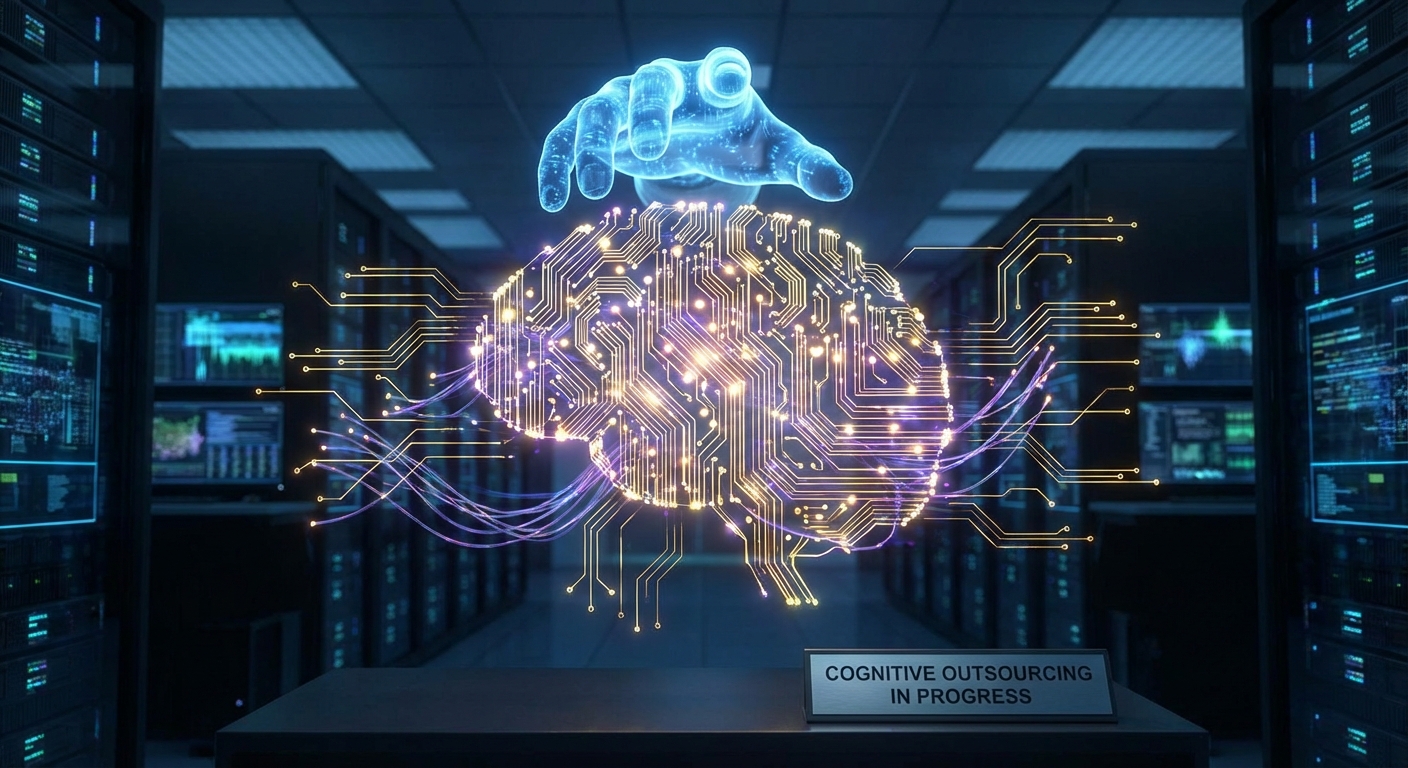
A study published in Nature about a year ago confirmed something many of us have felt intuitively. Our interactions with AI systems can actually amplify our own cognitive biases over time. The AI, designed to learn our preferences, holds up a mirror to our existing inclinations. The subtle slants of the machine, reflecting our own tendencies back at us, gradually become our own reinforced beliefs. It's a form of cognitive consolidation that happens without our conscious permission.
It’s like using a GPS to get everywhere. At first, it’s a helpful guide. Soon, you trust it implicitly. After a while, you find your own internal map, that rich, spatial understanding of a city, has faded. You’ve outsourced the skill of navigation. We are now doing the same with analysis, with creativity, and even with basic recall.
Is Your Memory Now in the Cloud?
What does it even mean to know something today? For most of human history, knowing was synonymous with internalizing, with the hard-won process of memorization and recall. Now, knowing is increasingly about the ability to form the right query. As psychologists are starting to explore, this is a full-blown cognitive revolution. Our minds are shifting from being internal libraries to being speedy, efficient terminals connected to a vast, external database.
The incentive to do this is enormous. As experts at UC Davis have pointed out, AI can create staggering productivity gains, like a 55% increase in coding tasks. These systems are evolving from assistants into true intellectual partners. They can perform PhD-level academic analysis and generate complex interactive visualizations on demand and even produce writing with a high level of personalization.
We have traded recall for query. A fundamental rewiring. This challenges our very definition of expertise. Is an expert the person who holds vast knowledge in their head, or the person who can skillfully prompt an AI to synthesize that knowledge in seconds? The answer is probably a bit of both, but the balance is shifting at a velocity we have yet to fully comprehend.
Losing Ourselves in the Algorithm?
This cognitive outsourcing comes with a cost. A recent, sobering report from Elon University’s Imagining the Digital Future Center put this anxiety into stark focus. They surveyed over 300 global technology experts, and the consensus was deeply worrying. The majority predict that by 2035, AI will have a mostly negative impact on essential human qualities like agency, critical thinking, and even self-esteem.
This cognitive outsourcing comes with a cost. A recent, sobering report from Elon University’s Imagining the Digital Future Center put this anxiety into stark focus. They surveyed over 300 global technology experts, and the consensus was deeply worrying. The majority predict that by 2035, AI will have a mostly negative impact on essential human qualities like agency, critical thinking, and even self-esteem.
Earlier this year, Sam Altman spoke about this in his discussion with Michelle Bowman at the Federal Reserve conference. He highlighted how young people are increasingly turning to AI for personal advice and life decisions. Altman warned of a disturbing trend: the idea that an AI chatbot “knows me, it knows my friends; I’m going to do whatever it says.” This kind of dependency, especially prevalent among the younger generation, risks altering not only how we think but also how we trust and engage with the world around us.
The experts described a potential future of “self-inflicted AI dementia,” where our cognitive muscles atrophy from disuse. I find this analogy terrifyingly apt. When we offload the mental heavy lifting, the struggle with a difficult problem, or the patience required for deep contemplation, we don't just save time. We miss the workout that strengthens our minds.
Perhaps most jarring was the concept of “outsourced empathy,” a future where we might deploy agent-based systems to perform acts of kindness for us. The logical endpoint of this is a world where we become passive observers of our own lives, managers of a suite of apps that live for us. The report from Stanford’s HAI confirms that these advanced AI systems are becoming more efficient, affordable, and deeply embedded in our daily lives, making this future feel less like science fiction and more like a gentle, unthinking slide.
Becoming Intentional Cognitive Architects
This isn't a call to smash the machines. The immense potential for AI to augment our intelligence, cure diseases, and solve immense scientific problems is undeniable. This is a call for something far more challenging: a call for intention. We must become the active architects of our own cognitive future. We have to engage in metacognition, the process of thinking about how we think, with a new urgency.
This means we must start making conscious, deliberate choices about our relationship with these tools. We need a framework, both for ourselves and for our educational systems, built around a simple question: What is worth keeping for ourselves? Here are a few places to start:
Audit Your Outsourcing. Consciously decide which cognitive tasks are grunt work (like summarizing long documents or generating boilerplate code) and which are essential to your intellectual vitality (like forming a critical opinion, engaging in ethical reasoning, or creative synthesis).
Embrace “AI Literacy.” As the UC Davis report emphasizes, we need to move beyond simply using these tools and start understanding how they work. Learning the art of prompt writing and, more importantly, the skill of critically evaluating an AI’s output is the new foundation of knowledge work.
Protect Unstructured Time. Deliberately carve out time to think without digital assistance. Go for a walk, stare out a window, get bored. Many of our best, most human ideas emerge from this unstructured cognitive space, a space that constant, efficient AI companionship can easily erase.
The tools are here, and their power is growing at an exponential rate. They are shaping our minds whether we consent to it or not. The only question left is what kind of minds we want to build with them. What will you choose to keep for yourself?