Trading Truths: Beyond the Indicators
Think you've been trading the right way? Think again. Many traders miss the mark by relying on outdated methods instead of diving deep into what the market data is really telling us. Let’s explore why that matters. In today's bulletin, we are covering:
- The Daily Grind: Frustrations of a Struggling Trader
- Why Your Go-To Indicators Just Aren't Cutting It Anymore
- The Real Deal: Data Interpretation Over Superficial Signals
- Enter MarketMonkey Terminal: Your New Trading Powerhouse
- Unpacking MarketMonkey: Liquidity Heatmaps and Advanced Order Flow Tools
The Daily Grind: Frustrations of a Struggling Trader
Let's be honest for a second. We've all been there, haven't we? Staring at those charts, eyes glazed over, trying to make sense of the squiggly lines and flickering candles. You've probably got your favorite setup: RSI divergence, MACD crossovers, a handful of moving averages fanned out across your screen like a digital rainbow. You've read the books, watched the gurus, maybe even dropped a few hundred (or thousand) bucks on that "secret strategy" everyone was raving about. Yet, here you are, account balance doing more dips than a DJ at a house party, or just barely ticking along. It's frustrating, isn't it? Infuriating, even.
You start the day with so much hope. Maybe you spotted a "perfect" head and shoulders pattern, or a textbook golden cross. You enter your trade, feeling confident, almost smug. Then, bam! The market does the exact opposite of what your indicators screamed. You get wicked out, only to see price reverse right back in your intended direction. Sound familiar? We've all felt that gut punch, that sickening feeling of being trapped, chewed up, and spit out by the market. You wonder, "What am I missing?" Or worse, "Is this whole thing just random? Am I just bad at this?"
It's a relentless cycle of hope and despair. You jump from one strategy to the next, tweaking settings, adding more indicators, convinced that the next magic formula is just around the corner. You spend hours poring over charts, analyzing every little move, but the consistent profitability just seems to elude you. You see others on social media flaunting their gains, talking about "reading the market," and you're left wondering how they do it. It feels like everyone else has the cheat code while you're stuck playing on hard mode, manually entering every single command. You’re trading blind, making decisions based on fragmented information, and that's a recipe for disaster in these volatile crypto markets (or any market, really).
Think about it:
- The emotional rollercoaster: Fear of missing out (FOMO) on those massive pumps, dread of holding through deep corrections. It's exhausting.
- Analysis paralysis: So many indicators, so much conflicting information. You freeze, or you take a trade based on too many signals, only for one to contradict the others.
- Lagging signals: By the time your moving averages cross or your RSI goes oversold, the move might already be halfway done, or even over.
- The "chop": You try to trade trends, but the market just ranges sideways, triggering your stops over and over. Your carefully crafted risk-to-reward ratio gets demolished by commissions and small losses.
- Lack of confidence: Each losing trade erodes your belief in your own ability, making you hesitate when a genuinely good setup comes along.
- The feeling of being manipulated: It often feels like large players are actively hunting your stop losses, pushing price just enough to liquidate you before moving in the "correct" direction.
These frustrations aren't just in your head. They are very real, and they stem from a fundamental misunderstanding of what truly moves markets. We've been told to rely on indicators that are, frankly, outdated for today's high-frequency, algorithm-driven trading environment.
Why Your Go-To Indicators Just Aren't Cutting It Anymore
Let's cut to the chase. You've got your chart loaded with indicators. The Relative Strength Index (RSI), your trusty companion for spotting overbought or oversold conditions. The Moving Average Convergence Divergence (MACD), that dynamic duo telling you about momentum and trend changes. Maybe some Bollinger Bands for volatility and potential reversals, or a stochastic oscillator doing its thing. These are the bread and butter of technical analysis, right? The foundations upon which countless strategies are built. And yes, they have their place in a complete trading plan (we're not saying they're useless, far from it).
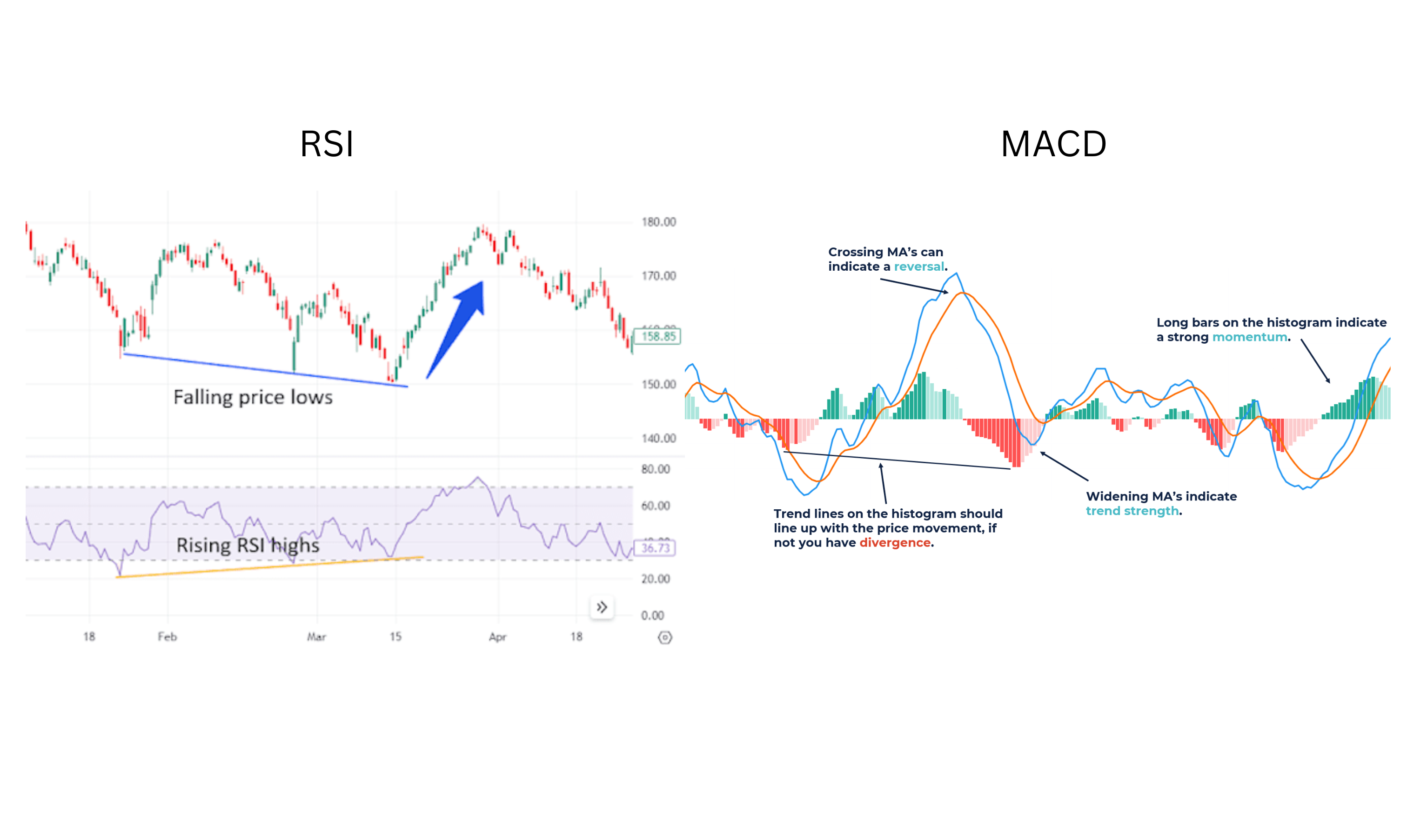 But here's the kicker: they're mostly lagging indicators. What does that mean? It means they process historical price data. They tell you what has already happened. By the time your MACD line crosses, or your RSI hits extreme levels, the smart money, the big players, they've often already positioned themselves. You're essentially looking in the rearview mirror while trying to navigate a Formula 1 race. It's tough. And in fast-moving, fragmented markets like crypto, "tough" usually means "loss-making."
Consider these points:
- They're derivatives of price: Indicators don't tell you about the underlying supply and demand. They just process price, which is the result of supply and demand. It's like trying to understand how a car works by only looking at the speedometer. You know how fast it's going, but not who's pressing the pedal or where the fuel is coming from.
- Lack of context: A bullish divergence on the RSI might look great, but if there's a massive liquidity wall just above current price, waiting to absorb all buying pressure, that divergence could lead you right into a trap. Traditional indicators offer no insight into this crucial context. They don't show you the battleground.
- Market manipulation: Large institutions, or whales, know where retail traders place their stops. They know the common indicator setups. They can use this knowledge to induce artificial movements, trigger your stops, and then move the market in the original direction. Your indicators don't account for this sophisticated game. They just react to the price action.
- Over-reliance leads to noise: The more indicators you stack on your chart, the more noise you introduce. Conflicting signals become rampant, leading to hesitation, missed opportunities, or impulsive decisions based on incomplete information. It becomes a mess of conflicting squiggles.
- They don't show conviction: Volume bars might show you how much was traded, but they don't show the aggressiveness of buying or selling. Was that volume driven by desperate buyers or panicked sellers? Was it absorption or outright capitulation? Your standard volume indicator won't tell you that.
We've all been there, meticulously backtesting strategies built on these indicators, finding historical profitability, only to watch them fail miserably in live market conditions. Why? Because the market isn't static. It's a dynamic, living entity driven by the push and pull of real orders, real liquidity, and real human (and algorithmic) emotion. And your average charting tool just isn't designed to show you that intricate dance. You're using a flashlight to look for a needle in a haystack, when what you really need is an X-ray machine.
The Real Deal: Data Interpretation Over Superficial Signals
So, if traditional indicators are just showing us the past, what's the secret sauce? What are those "successful" traders looking at? The answer, my friends, isn't another magical indicator. It's about moving beyond superficial signals and diving deep into the true drivers of price: supply and demand, liquidity, and the order flow itself. It's about data interpretation, not just data display.
Think about it this way: price is a reflection of transactions. For every buyer, there's a seller. But what determines where these transactions occur, and with what conviction? It's the orders that are sitting there, waiting to be filled. It's the large blocks of capital positioned at certain price levels. It's the aggressive market orders slamming into passive limit orders. This, my friends, is the heartbeat of the market. This is what truly matters.
Here's why focusing on deep data interpretation is a game-changer:
- Understanding intent: When you see large orders building up at a certain price, you're seeing intent. Whether it's a whale trying to accumulate or distribute, or a large institution protecting a position, this information is invaluable. Your RSI isn't going to tell you that.
- Identifying true support and resistance: Price often reacts to levels where significant liquidity exists. These aren't just arbitrary lines on a chart based on past price action. They are actual zones where large amounts of buy or sell pressure are waiting. Knowing where these "liquidity magnets" are gives you a massive edge.
- Spotting absorption and exhaustion: When aggressive market orders hit a wall of limit orders and fail to push price significantly, that's absorption. When buying or selling pressure wanes after a big move, that's exhaustion. These are critical clues for potential reversals or continuations that simple candlestick patterns or lagging indicators will miss.
- Seeing the "unseen": Much of the market's internal dynamics, the actual battle between buyers and sellers, occurs beneath the surface of the typical candlestick chart. It's in the order book, in the individual trades, in the flow of volume at each price level. This granular data, when properly visualized, is what truly informs intelligent trading decisions.
- Proactive vs. Reactive: Instead of reacting to what price has already done, you can become more proactive, anticipating where price might move, where it might meet resistance, or where a large player might be accumulating. This shifts your mindset from guessing to informed decision-making.
So, how do we get this deeper insight? How do we move beyond the superficial and really see the market's inner workings? We need tools that are specifically designed for this purpose. We need something that goes beyond the basic charting packages that most retail traders use. We need to upgrade our arsenal, big time.
Enter MarketMonkey Terminal: Your New Trading Powerhouse
This is where MarketMonkey Terminal swings in like a superhero. It's not just another charting platform; it's a quantum leap in market analysis. If you've been feeling frustrated, if you've been hitting that wall trying to make consistent profits with the old methods, then get ready for a paradigm shift. MarketMonkey Terminal is designed from the ground up to address exactly these pain points. It's built for traders who understand that the future of market analysis isn't in more lagging indicators, but in richer, real-time data interpretation.
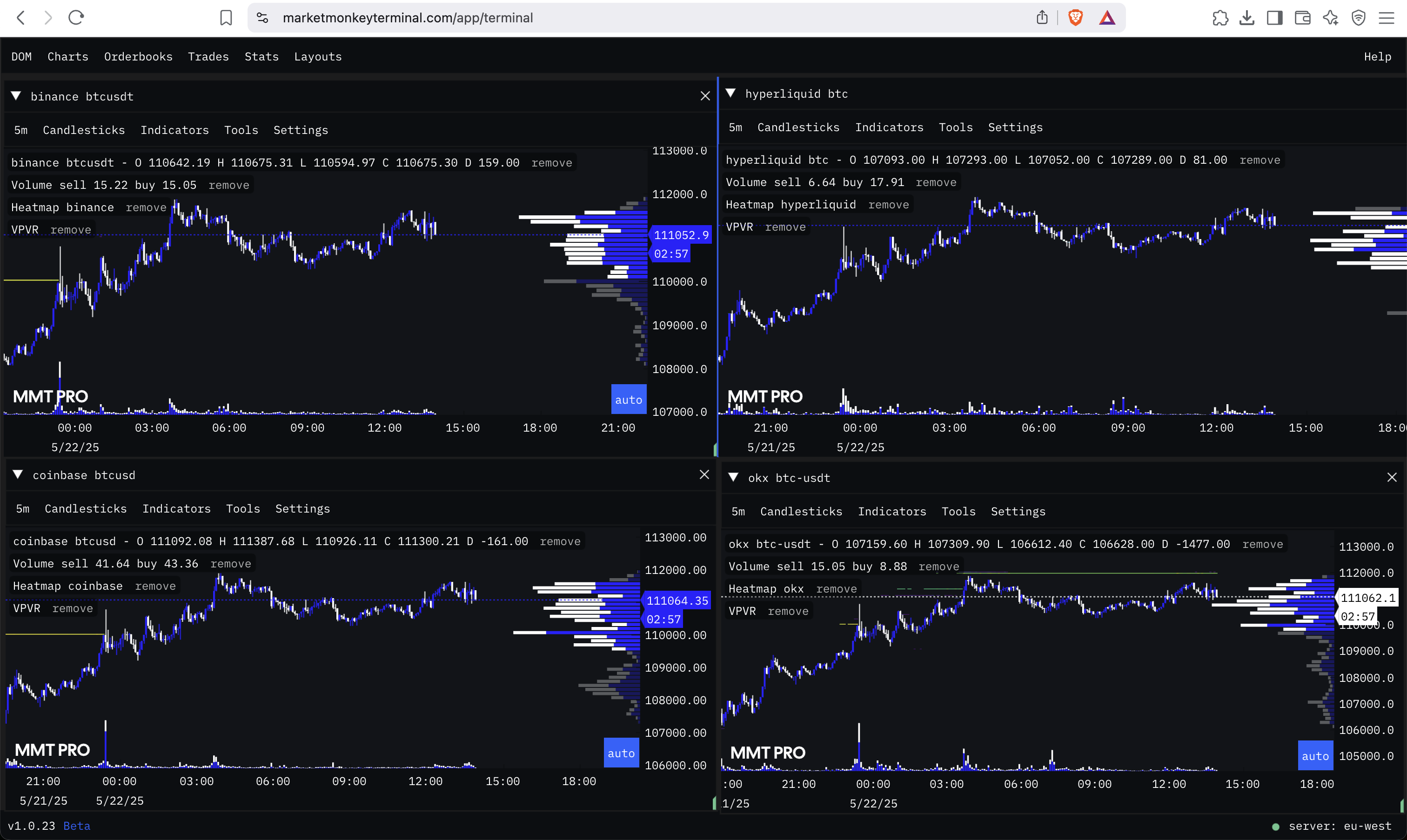 Attached is an image of MarketMonkey Terminal displaying four charts from different exchanges: Binance, Coinbase, Hyperliquid, and OKX. This platform offers you an unfair advantage by allowing you to "read between the lines" of the market. It goes far beyond basic candlesticks and simple volume bars. MarketMonkey Terminal provides a comprehensive set of advanced tools that reveal the real forces behind price movements: aggregated liquidity, real order flow, and true market depth. Think of it as an X-ray machine showing the bones and sinews of market structure, not just the surface.
This is not about crowding your screen with more indicators. Instead, it delivers the right data, presented intuitively, so you can make well-informed, high-probability decisions. It helps you understand why the price moves, not merely that it does. It reveals the activity of major players, the whales, so you can position yourself strategically.
MarketMonkey Terminal is the definitive solution for traders who are serious about elevating their performance. It's built on the understanding that true success in trading comes from interpreting advanced market data, not just relying on superficial signals. It’s designed to help you stop losing sleep over market moves you didn’t anticipate and start trading with confidence. Think of it as your tactical command center for navigating the complex crypto landscape.
Let’s dive into some of the core offerings that make MarketMonkey Terminal truly groundbreaking and will directly address the frustrations we've discussed.
Unpacking MarketMonkey: Liquidity Heatmaps and Advanced Order Flow Tools
Alright, let's get into the nitty-gritty. What exactly does MarketMonkey Terminal offer that sets it apart? We're talking about features that pull back the curtain on market dynamics, giving you insights you simply can't get from standard charting software like TradingView (bless its heart, it's great for what it is, but it's not this).
Real-time Aggregated Liquidity Heatmaps
This is, without a doubt, one of MarketMonkey Terminal’s killer features, and a cornerstone of truly understanding market structure. Imagine being able to see where all the significant pending buy and sell orders are sitting across multiple exchanges, all in one aggregated view. That's what the Real-time Aggregated Liquidity Heatmaps do.
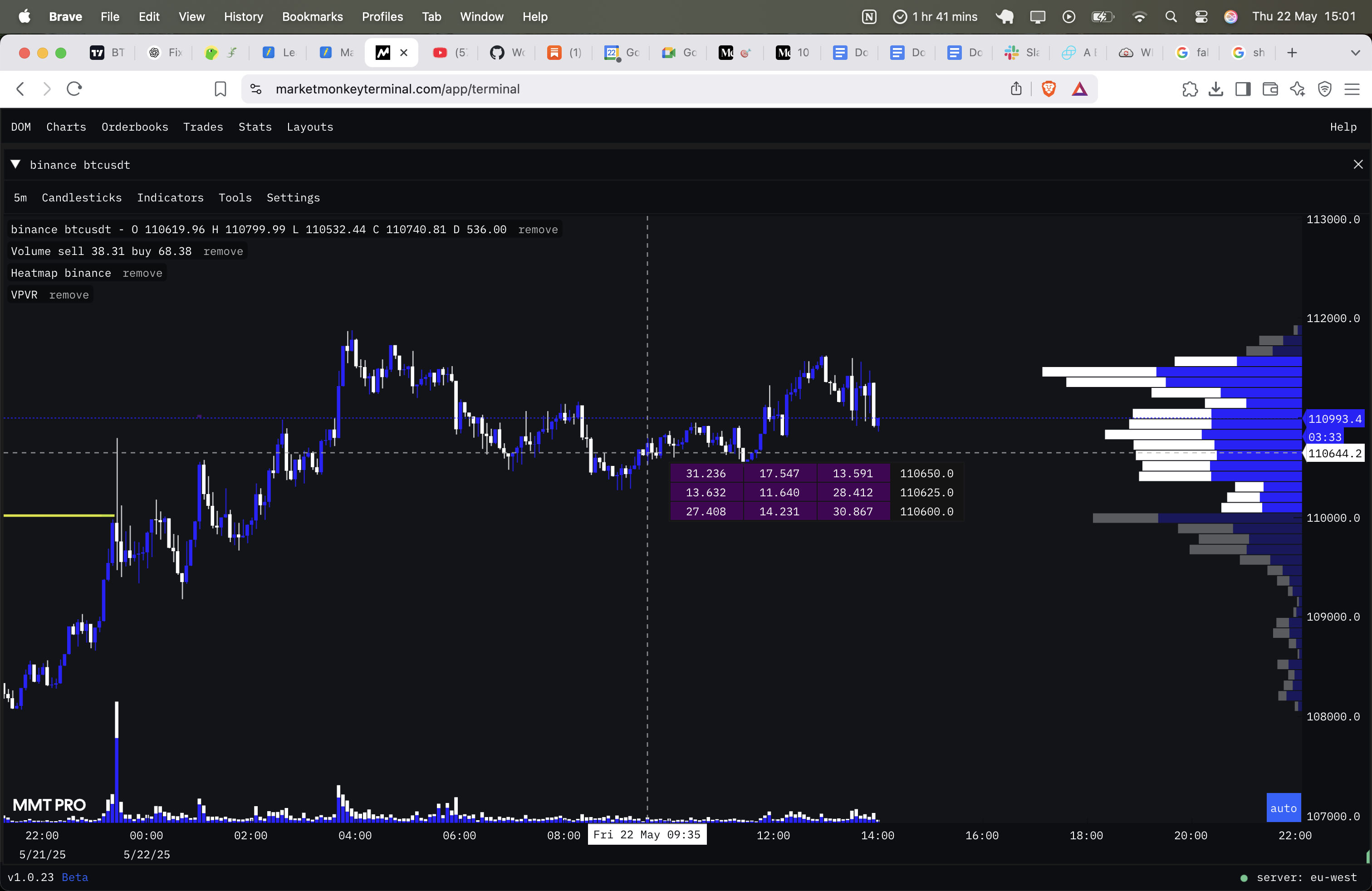 - What they are: Picture your chart, but instead of just candlesticks, you have vibrant, dynamic heatmaps showing the density of limit orders. Red typically indicates large sell walls (asks), and green indicates large buy walls (bids). The brighter the color, the more liquidity is present at that price level. And here's the genius part: it's aggregated across all the major exchanges, giving you a holistic view of the market's true depth, not just a single exchange's fragmented order book.
- Why they are crucial:
- Identifying true support and resistance: Forget drawing arbitrary lines. These heatmaps show you actual liquidity levels where buying or selling pressure is concentrated. Price often gravitates towards or gets rejected by these zones. They are dynamic supply and demand zones in real time.
- Spotting liquidity traps and stop hunts: Whales often place large orders to bait retail traders, or to create a false sense of security before pulling them. The heatmap allows you to see these large orders and understand their potential impact. You can see where stop losses are likely to be hunted because there's a big pool of liquidity just waiting to be taken out. * Forecasting price movement: If price is approaching a thin liquidity zone, it might slice right through. If it's hitting a massive wall of orders, it's more likely to bounce or consolidate. This gives you a forward-looking perspective, unlike lagging indicators.
- Understanding market sentiment: Are bids building up aggressively below current price? That suggests strong buying interest and potential for upward movement. Are offers stacking heavily above? That could signal overhead supply.
- Seeing hidden orders: While not perfectly revealing dark pools, these heatmaps provide unparalleled transparency into the visible order book depth across the entire ecosystem. You can identify potential areas of accumulation or distribution by institutional players.
Imagine seeing a big green wall forming just below your entry, confirming strong support. Or spotting a massive red wall just above your target, signaling a likely reversal point for your short. This isn't theoretical; it's real-time, actionable data. It's like having X-ray vision for the order book. No more guessing where the liquidity is; you see it with your own eyes.
Advanced Order Flow Tools
Beyond static liquidity, the market moves because of order flow the actual buying and selling activity hitting the exchanges. MarketMonkey Terminal provides an advanced toolkit to dissect this flow, revealing the conviction and intent behind price movements. This goes way beyond basic volume bars.
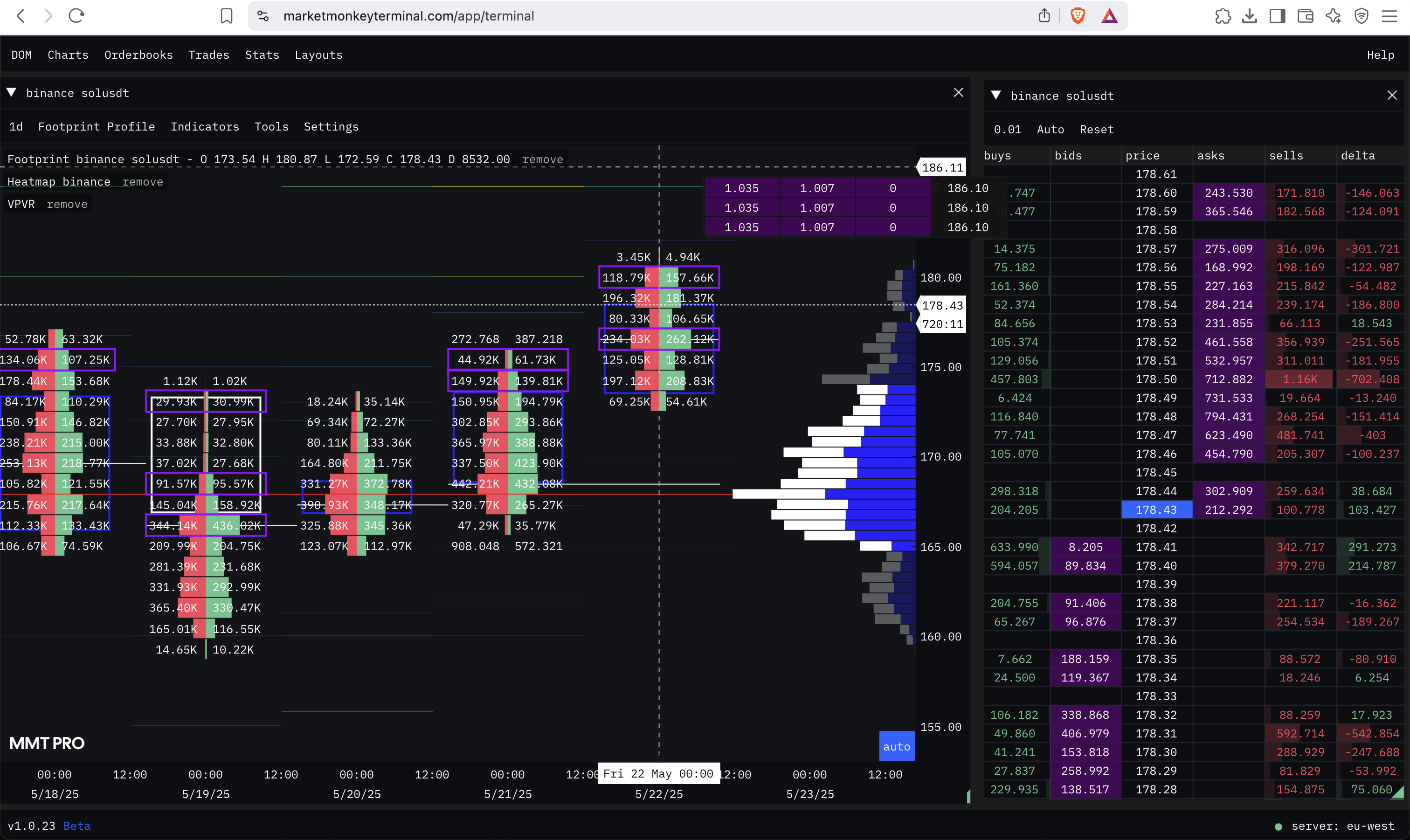 - Footprint Charts (Cluster Charts): These are perhaps the most powerful tools for granular order flow analysis. Instead of just seeing one candlestick for a period, footprint charts show you the volume and aggressive buy/sell orders that transpired at each individual price level within that candle.
-
Delta Views: The net difference between aggressive buy and sell market orders at each price level. A positive delta means more aggressive buying; a negative delta means more aggressive selling. This helps you understand the conviction behind moves. Are buyers stepping in forcefully, or is it just passive buying absorbing sells?
-
Point of Control (POC): The price level within a candle where the most volume was traded. This shows where the most activity occurred, often acting as a magnet or a rejection point.
-
Imbalances: Highlights areas where aggressive buy orders significantly outpaced sell orders (or vice-versa) at specific price levels. These imbalances reveal strong conviction and can act as areas of support or resistance for future price action. Seeing these allows you to gauge true strength or weakness.
-
Why they are crucial: Footprint charts let you see the actual battle happening inside each candle. You can spot absorption, exhaustion, and aggressive participation that standard charts completely hide. For example, a bullish candle with a negative delta at the top could indicate sellers stepping in aggressively, absorbing the buys, hinting at a potential reversal. This is a game-changer for understanding micro-structure and making precise entries and exits.
-
Depth of Market (DOM) Widget: The DOM is a real-time list of all buy (bids) and sell (asks) orders for a specific asset at different price levels. While heatmaps aggregate this visually across exchanges, the DOM widget provides a focused, live, interactive view for a single exchange, letting you see the immediate liquidity.
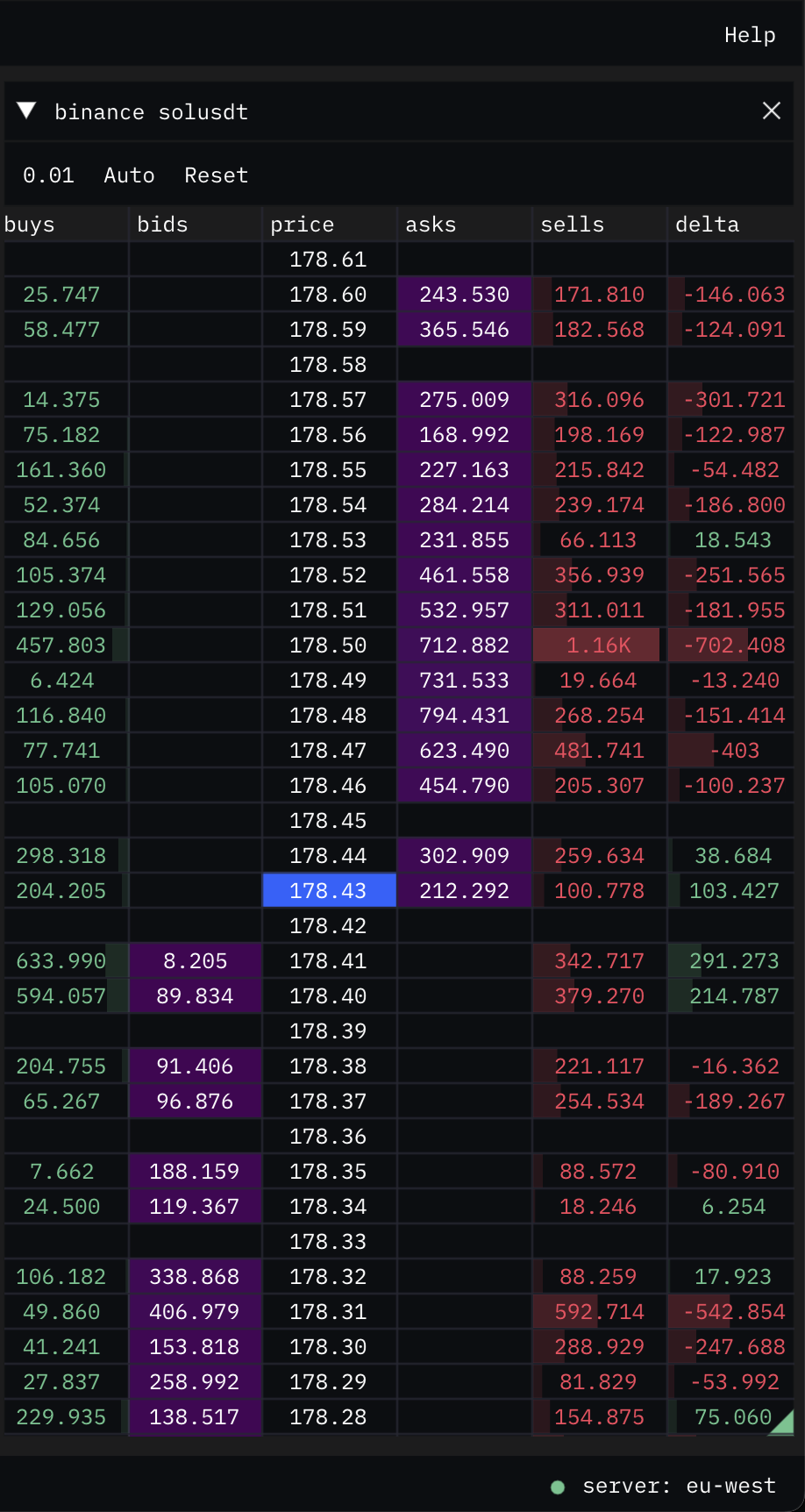 - Why it is crucial: It shows you the immediate supply and demand right at the current price. You can see orders getting placed, moved, or pulled in real-time. This dynamic view is essential for scalpers and day traders looking for ultra-short-term opportunities. You can spot spoofing attempts (large orders placed and then pulled) and understand the true intent of participants trying to push or absorb price.
 -
Cumulative Volume Delta (CVD): This indicator aggregates the delta (net aggressive buying minus selling) over time.
- Why it is crucial: While individual footprint delta tells you about a candle, CVD tells you the overall aggressive buying or selling pressure over a longer period. If price is going up but CVD is trending down, it could indicate that the move is weak and sustained by passive buying rather than aggressive participation a potential divergence that foreshadows a reversal. It’s like a running tally of who’s winning the aggressive battle.
-
Volume Profile (VPVR/VPSV): This visualizes the total volume traded at each price level over a specified period or visible range.
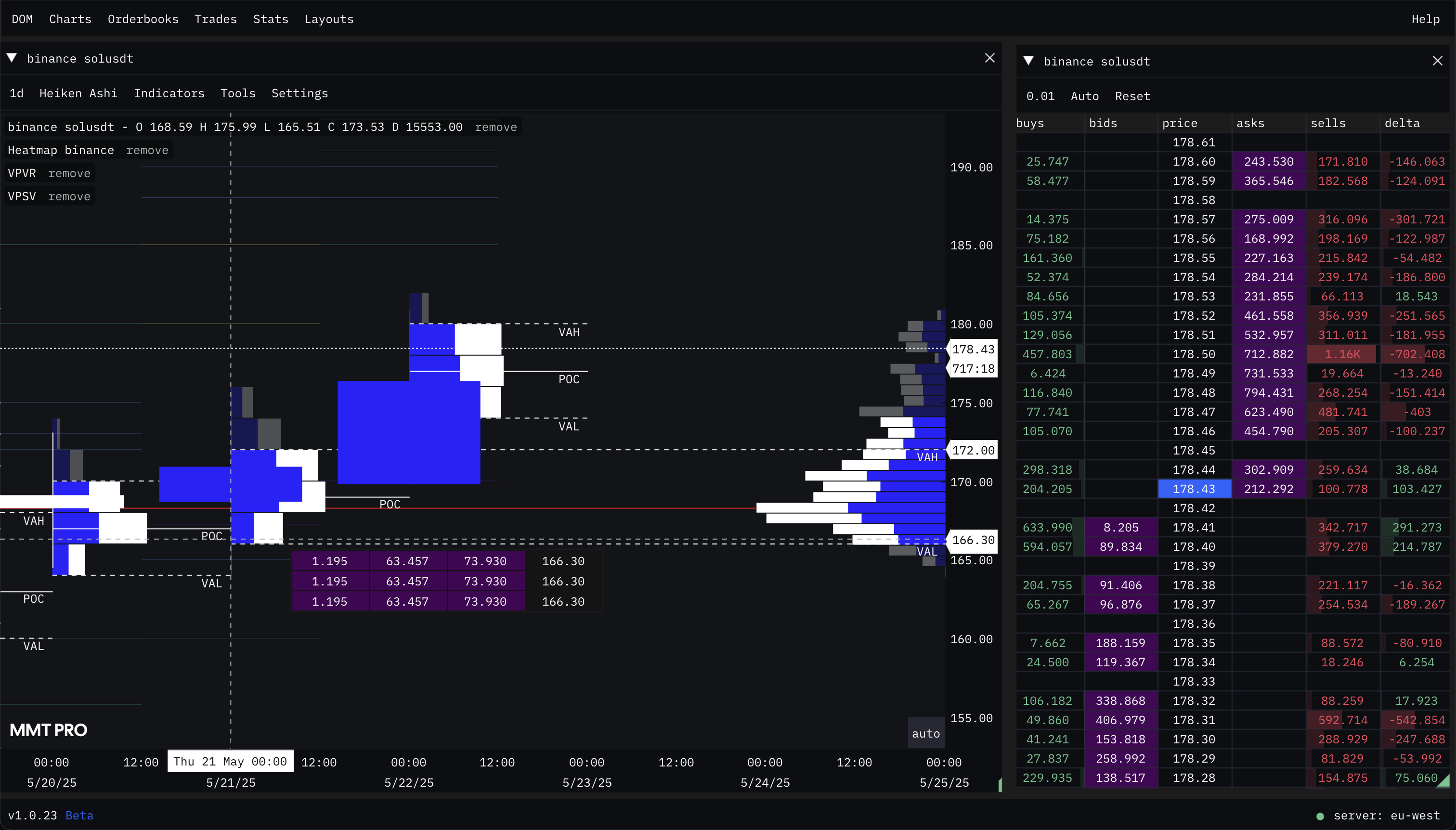 - Why it is crucial: It highlights price areas where significant trading activity occurred (high volume nodes) and areas where little activity occurred (low volume nodes). High volume nodes often act as strong support or resistance, as many participants are "stuck" at those levels. Low volume nodes, on the other hand, often act as magnets for price movement, as there's less resistance there. This provides a clear roadmap of price acceptance and rejection areas.
These tools, combined, offer an unparalleled view into the mechanics of the market. You're not just looking at where price is; you're seeing why it's there and where it's likely to go next, based on the real flow of orders and the positioning of significant liquidity. It’s the difference between trying to read a blurry photo and having a high-definition video of the entire scene unfold.
In short, MarketMonkey Terminal gives you the ability to trade with precision, confidence, and genuine understanding. No more guessing, no more relying on lagging signals that leave you in the dust. You’ll be able to see the market like never before. And trust us, once you see it, you'll wonder how you ever traded without it.
The Unfiltered Lens: True Tick-Level Data and Next-Gen Liquidity Analysis
Alright, we’ve covered how MarketMonkey Terminal rips apart the veil of traditional charting, giving you the real-time aggregated liquidity heatmaps and advanced order flow tools you need to stop guessing and start understanding. But that's just the beginning. To truly read between the lines, to see the market's pulse with unparalleled clarity, we’re diving even deeper into MarketMonkey's arsenal. This isn't just about indicators; it’s about mastering market data itself.
True Tick-Level Market Data: Seeing Every Single Breath of the Market
Let's face it, most charting platforms give you aggregated data, smoothed-out candles, and a simplified view of market activity. They batch trades, round off volumes, and effectively obscure the intricate dance of supply and demand that truly moves price. It’s like watching a football game on a tiny, blurry screen and trying to understand every player's move. You just can’t.
MarketMonkey Terminal changes the game with True Tick-Level Market Data. What does that mean for you, the diligent trader? It means you get unfiltered, raw, precise data for every single buy and sell volume, exactly as it happens. We’re talking about sub-millisecond precision, showing you every trade, every executed order, every price change, without any arbitrary aggregations or filters. This is the granular truth of the market, laid bare.
Why is this not just a "nice-to-have" but an absolute "must-have" for any serious trader?
- Unmasking Hidden Dynamics: When data is aggregated, crucial details are lost. You might see a big green candle, but with tick-level data, you can see if that move was driven by a single massive whale order or a rapid succession of smaller, retail buys. This distinction is vital for understanding true conviction and avoiding whipsaws.
- Spotting Institutional Footprints: Large players, the whales that often dictate market direction, don't just "buy" or "sell." They often employ sophisticated strategies like iceberg orders or spoofing. With tick-level data, you can often detect the subtle clues these entities leave behind, helping you position yourself in alignment with smart money, not against it. You're no longer just seeing the waves; you’re seeing the currents underneath.
- Understanding Liquidity Gaps and Flash Crashes: Sometimes, price moves with incredible speed, leaving "gaps" on the chart. Tick-level data allows you to analyze these events with extreme detail, showing exactly how liquidity vanished or appeared, giving you insights into market fragility or strength that aggregated data simply can't provide. This helps you anticipate potential areas of high volatility or illiquidity.
- Eliminating Misinterpretations: Traditional volume indicators can be misleading if you don't know the underlying microstructure. A large volume bar could mean a big reversal, or it could mean a lot of small trades at the same price. Tick data removes this ambiguity, allowing you to interpret volume with confidence and context, making your analysis more robust and reliable.
It’s all about getting rid of the noise and seeing the pure, unadulterated truth of market activity. True tick-level data provides an unparalleled competitive edge, letting you analyze market movements with a forensic level of detail that other traders simply can't access with their conventional tools.
Next-Gen Liquidity Analysis: Decoding the Order Book's Secrets
Beyond the raw tick data, MarketMonkey Terminal elevates your understanding of market dynamics with Next-Gen Liquidity Analysis. This isn't just looking at a static order book; it's about interpreting the intentions and imbalances within that data. You're learning to speak the language of supply and demand, not just observing its surface.
This suite of tools is designed to give you a dynamic, in-depth view of market participants' intentions, before they even translate into executed trades.
Order Book Imbalances: The Scales of Supply and Demand
Think of the order book as a set of scales, with buy orders on one side (bids) and sell orders on the other (asks). Most of the time, we just look at the total depth, but MarketMonkey Terminal lets you dive into Order Book Imbalances. This means actively measuring the strength of the bid side versus the ask side at various price levels.
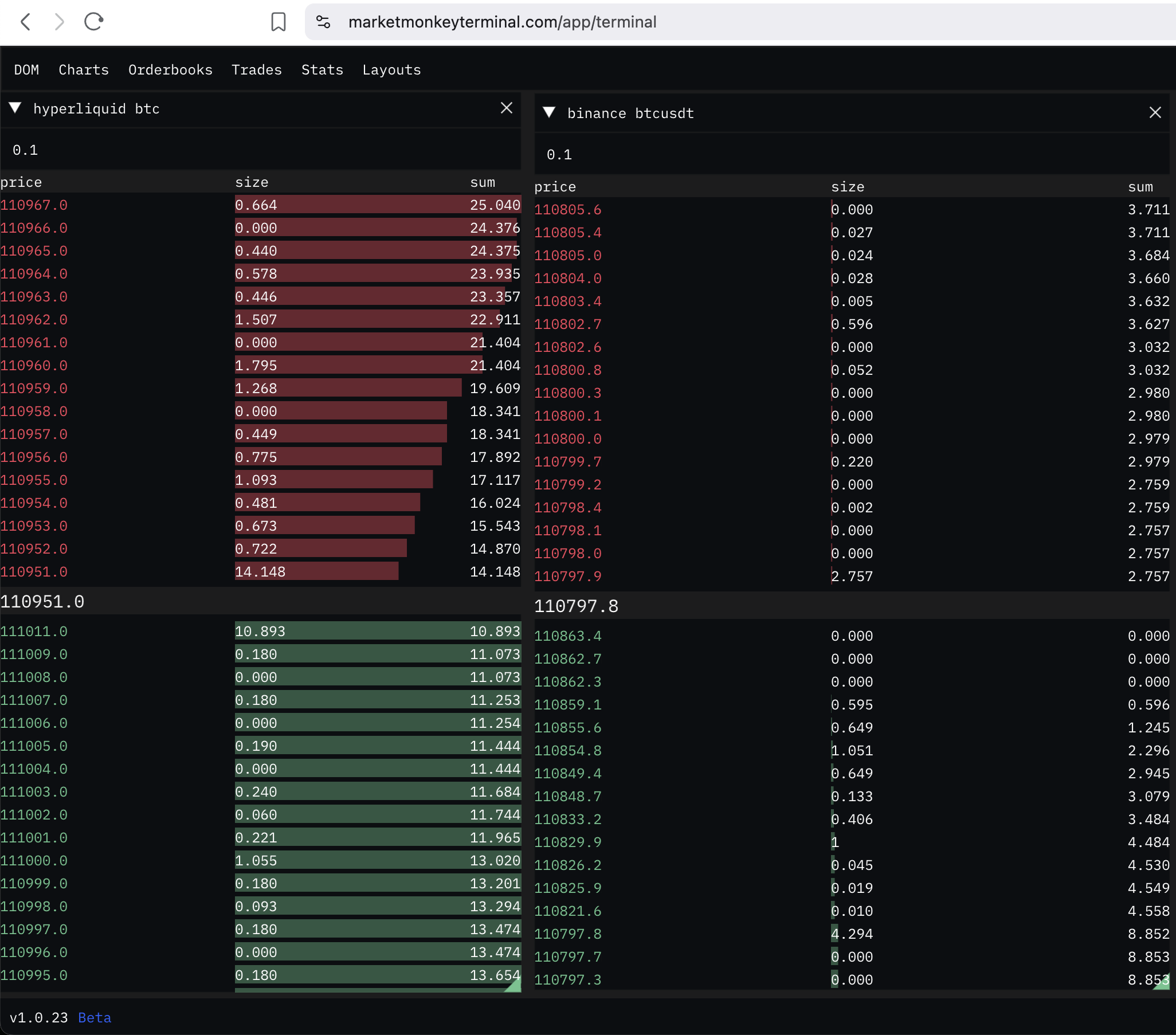 Why is understanding these imbalances so crucial for reading between the lines?
- Predictive Power: Significant imbalances often precede price movements. If there’s a massive accumulation of buy orders (bids) below the current price compared to sell orders (asks) above, it suggests strong underlying demand and potential support. Conversely, an overwhelming stack of asks above could indicate heavy resistance or impending downward pressure. It helps you anticipate where the path of least resistance for price might be.
- Gauging Conviction: These imbalances don't just show quantity; they show conviction. A persistent, growing imbalance on one side suggests strong institutional interest or a concerted push by a particular cohort of traders. It tells you where the dominant force currently lies.
- Identifying Liquidity Traps and Fake Walls: Large orders placed on the order book aren't always real. Sometimes they’re "spoofing" or "iceberg" orders designed to trick retail traders. By analyzing imbalances in real-time, especially when combined with order flow tools, you can often discern if these large orders are legitimate expressions of supply/demand or merely temporary facades, helping you avoid falling into these liquidity traps.
- Refining Support and Resistance Levels: While traditional charting uses historical price levels, order book imbalances give you real-time, dynamic support and resistance. These aren't just lines on a chart; they are active zones where significant liquidity is positioned, acting as magnets or barriers for price.
DOM Insights: The Real-Time Battleground
The Depth of Market (DOM) widget is the raw, live battlefield of trading. It’s a vertical display of all the outstanding buy and sell orders for a specific asset, arranged by price level, updating in real-time. But MarketMonkey Terminal takes DOM beyond a simple display; it turns it into a powerful insight engine.
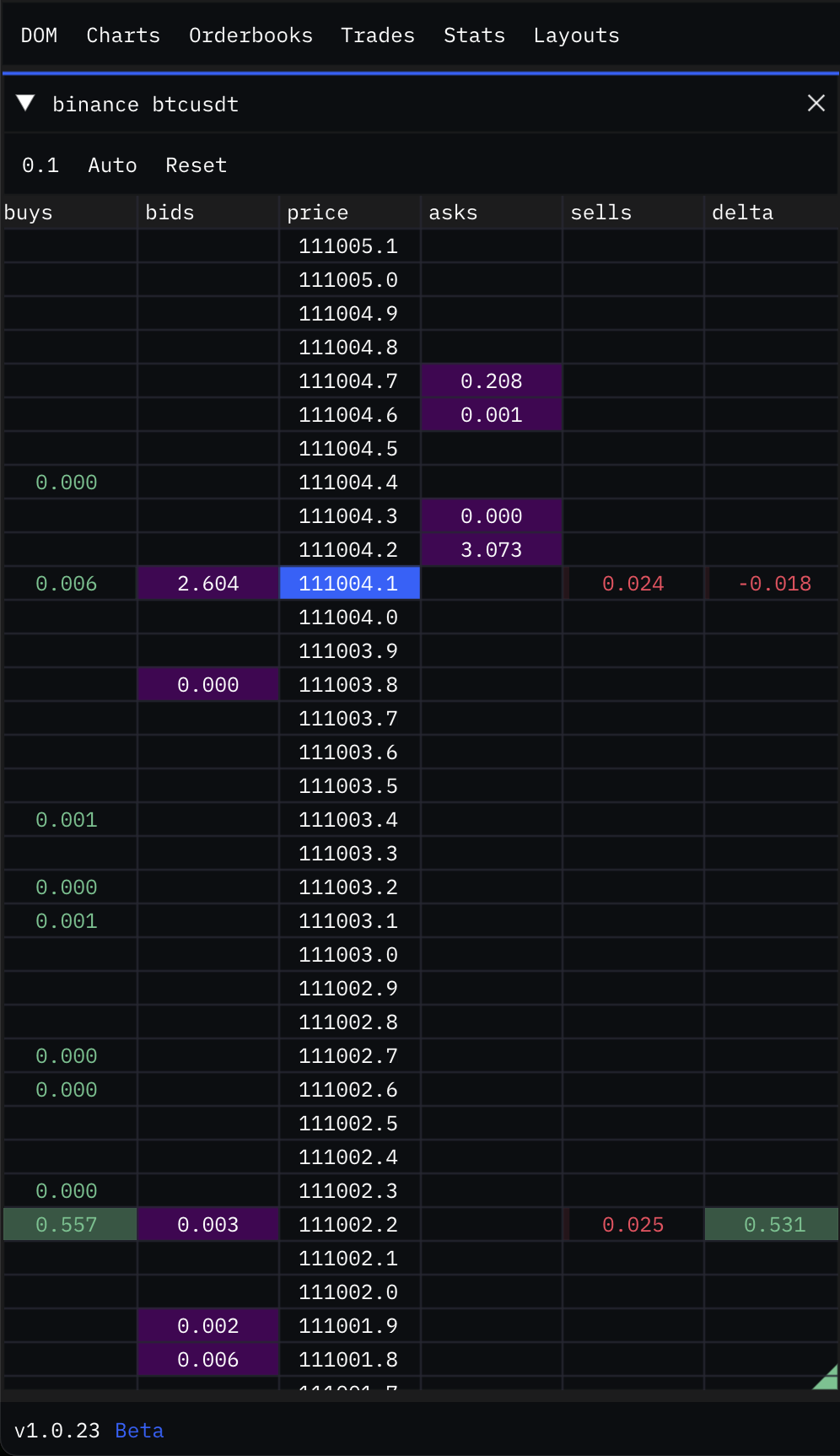 Why is the DOM, empowered by MarketMonkey's next-gen analysis, indispensable?
- Immediate Market Sentiment: The DOM provides an immediate, unfiltered look at current supply and demand. You can instantly see where the deepest pockets of liquidity are, indicating potential areas of support or resistance in the very near future. This is critical for scalpers and day traders who need to make rapid decisions.
- Identifying Large Orders: Major block orders, whether hidden (iceberg orders) or visible, stand out on the DOM. Tracking these helps you understand where significant capital is positioned and where the "smart money" is likely to be operating. Knowing this gives you a substantial edge in understanding market dynamics.
- Visualizing Order Flow Pressure: As orders are placed, modified, or canceled, you can literally watch the liquidity on the DOM shift. This dynamic visualization of order flow pressure helps you anticipate micro-movements before they appear on your candle charts. It’s like having a real-time X-ray of the market's intentions.
- Optimizing Entries and Exits: When you're ready to enter or exit a trade, the DOM shows you the exact prices at which you can expect your orders to be filled and the immediate liquidity available. This minimizes slippage and allows for precise execution, which is crucial for managing your risk and maximizing your profit potential. You can see how much "room" you have to maneuver.
- Confirming Price Action: Often, price will react precisely to levels where significant liquidity or imbalances are visible on the DOM. This provides an excellent confirmation for your technical analysis, giving you higher conviction in your trades. You’re not just seeing what happened; you’re seeing why it happened, in real time.
By combining the granularity of True Tick-Level Market Data with the dynamic insights from Order Book Imbalances and DOM, MarketMonkey Terminal doesn't just show you the market; it helps you truly understand its inner workings. It's about seeing the mechanics, the psychology, and the raw power driving price.
Beyond Indicators: The Edge You've Been Craving
We’ve seen how traditional indicators, while useful for basic charting, simply fall short when it comes to capturing the intricate, real-time dynamics of today's volatile crypto markets. You've experienced the frustration: lagging signals, analysis paralysis, and that nagging feeling that you're always a step behind. We’ve all been there. It’s easy to feel like you’re constantly fighting an uphill battle, relying on tools that give you historical data rather than forward-looking insights.
MarketMonkey Terminal is the definitive answer to that frustration. It’s not just another charting software; it's a paradigm shift in how you interact with market data. It transcends the limitations of conventional tools by providing:
- Real-time Aggregated Liquidity Heatmaps: Visualizing the true global supply and demand across exchanges.
- Advanced Order Flow Tools: Footprint charts, delta views, and cumulative volume delta, revealing precise executed volume.
- True Tick-Level Market Data: The unfiltered truth of every single trade, giving you an unparalleled view of market microstructure.
- Next-Gen Liquidity Analysis: Dynamic Order Book Imbalances and in-depth DOM insights, allowing you to anticipate moves and optimize execution.
This integrated approach means you're no longer just looking at a price chart; you're peering into the very soul of the market. You're identifying institutional footprints, understanding true supply and demand dynamics, and making decisions based on live, granular data, not just historical patterns or delayed signals.
Think about the difference this makes:
- You’ll stop guessing where the next big move is coming from and start knowing.
- You’ll cut down on unnecessary losses by understanding exactly where liquidity lies.
- You’ll gain the confidence to execute trades with precision, knowing you have the deepest possible market intelligence at your fingertips.
- You’ll move beyond the "cut winners too early, let losers run" trap because you'll have clearer signals and better conviction.
MarketMonkey Terminal empowers you to cultivate a more disciplined, informed, and ultimately, more profitable trading plan. It aligns with the truth that success in trading isn't just about the tools you use; it's about your ability to interpret market data and execute a structured strategy. MarketMonkey simply gives you the superior data interpretation capabilities you need to make that strategy sing.
It's time to stop relying on inadequate tools that leave you frustrated and behind the curve. It’s time to equip yourself with the unfair advantage that the pros use.
Ready to finally break free from the cycle of frustration and unlock your true trading potential? Ready to see the market not as a mystery, but as a solvable puzzle?
Don't just trade the market; understand it. Try MarketMonkey Terminal today and experience the difference.
Head over to marketmonkeyterminal.com now and start your journey towards elevated trading performance. Your future as a successful trader starts here.